Péter Techet for Frankfurter Rundschau on Péter Magyar’s chances

In the German daily newspaper Frankfurter Rundschau, Péter Techet was also asked whether and how Péter Magyar, the conservative challenger of Viktor Orbán, could win in the next elections. 

The article can be read here 

Péter Techet for STVR Pátria Rádió on Russian Interference in Hungarian Domestic Politics

In an interview with the Hungarian-language program of Slovak Radio, Péter Techet spoke about Russia’s attempts to influence the Hungarian election campaign in Viktor Orbán’s favor. 

The interview can be listened to here 

Péter Techet for Campus A on Aleksandar Vučić

In the Austrian online magazine Campus A, Péter Techet was also asked whether the current protests in Serbia could lead to a change of power. 

The article can be read here 

Péter Techet for NZZ on Ethnopluralism 

In an essay for the Swiss daily Neue Zürcher Zeitung, Péter Techet explores why right-wing populist parties view a multipolar world of sovereign nation-states as an expression of diversity, yet at the same time reject diversity within the society. Techet traces this perspective back to thinkers such as Carl Schmitt and Alain de Benoist, who advocated for a world of separate, homogeneous nation-states and regarded internal diversity as a threat to domestic politics. 

The article can be read here: https://www.nzz.ch/meinung/andersheit-a-la-carte-fuer-die-rechte-soll-die-welt-aus-klar-getrennten-homogenen-nationalstaaten-bestehen-innerhalb-des-eigenen-staates-aber-sehen-sie-differenzen-als-gefahr-ld.1889321  

Péter Techet for ATV (Hungary) about the Rise of the AfD 

In an interview with the Hungarian television channel ATV, Péter Techet explained why the AfD is gaining more and more influence and popularity in Germany, and whether the CDU/CSU will be able to maintain its firewall against the far-right party even after next year’s elections in Eastern Germany.

The interview can be listened to here: https://www.atv.hu/videok/hogyan-tovabb-afd-betilthatjak-a-partot/

Malwina Talik on Anne Applebaum’s Warning Speech at the Opening of the Salzburg Festival for Polskie Radio

The publicist Anne Applebaum, recipient of the Pulitzer Prize and the Peace Prize of the German Book Trade, opened the Salzburg Festival with a warning speech. She addressed the dangers facing democracy and the rule of law. In a conversation with Jakub Kukla from Polskie Radio, Malwina Talik commented on how Applebaum’s speech was received in Austria and how attitudes toward Russia have changed since the full-scale invasion. 

You can listen to the whole interview (in German) here. 

Sebastian Schäffer for Fair Observer: “How to Write Disinformation, I Mean, the Truth”

In June 2025, IDM Director Sebastian Schäffer and Research Associate Malwina Talik co-authored the article Russian Influence in Central Europe Evolves From Disinformation to Democratic Erosion for Fair Observer. When the piece was finally published, Schäffer remarked on social media: “I could write an article about writing this article.” Fair Observer took him at his word.

In his follow-up contribution, Schäffer warns of a growing trend of self-censorship within media, think tanks, and policy circles. Based on his ongoing research into Russian disinformation, he argues that avoiding clear terms like disinformation undermines democratic discourse. He calls on institutions to resist ambiguity and defend intellectual integrity in the face of rising authoritarian influence.

Read the whole article here.
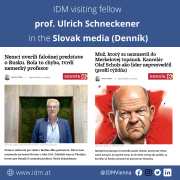
Péter Techet for N1 Info on the Far-Right Instrumentalization of Srebrenica

For the Bosnian news channel N1 Info, Péter Techet spoke about why far-right forces in Europe, especially in Germany, are instrumentalizing the genocide in Srebrenica for their own purposes, as if a heterogeneous society would inevitably lead to such conflicts. 

Techet emphasized that Srebrenica did not become a symbol of ethnic violence because of its heterogeneity, but as a result of the attempt to homogenize the town.  

In this context, Techet explained that Bosnia and Herzegovina can only function as a state if its constitution does not further entrench ethnic divisions. A society can indeed be composed of various ethnic groups; however, this does not mean that these differences alone should be the defining basis for the structure of the state and society. 

The interview can be listened here.

Péter Techet for Die Presse on Srebrenica

On the occasion of the 30th anniversary of the genocide in Srebrenica, Péter Techet wrote an op-ed for the Austrian daily newspaper Die Presse. In his article, he emphasizes that attempts to create homogeneity in an ethnically and religiously diverse society lead to violence and contradict the idea of a pluralistic democracy: In a pluralist democracy, the people are not meant to form a homogeneous unit. 

The article can be read here.

The Bosnian news channel N1 also reported on Techet’s commentary.

Energiegemeinschaften im Westbalkan

In einem Gastbeitrag für die österreichische Tageszeitung Der Standard beleuchtet Rebecca Thorne erfolgreiche Energiegemeinschaftsprojekte in Albanien, Nordmazedonien und Serbien. Zudem werden die politischen Rahmenbedingungen sowie die Hürden auf dem Weg zu einer nachhaltigen Energiezukunft im Westbalkan analysiert. Der Beitrag erschien gleichzeitig auch auf dem Blog der Forschungsgruppe Osteuropa am Institut für Politikwissenschaft der Universität Wien.

Lesen Sie den ganzen Artikel hier.