Without a Just Peace, There Is Just Peace – Sebastian Schäffer

In the latest op-ed on the IDM Blog, Sebastian Schäffer reflects on the debate about how to achieve peace in Russia’s ongoing war of aggression against Ukraine. While all parties and their supporters call for peace, their visions of what it should look like differ dramatically. Do we seek just peace in the sense of merely ending hostilities, or just peace in the sense of a fair and sustainable settlement? This is the central question the op-ed explores. 

“If accepting the temporary occupation of part of its territory is what ensures Ukraine’s survival as an independent sovereign state, then so be it,” said Czech President Petr Pavel to the BBC in August 2025. While his remarks caution against pressuring Kyiv to reconquer all territory at once, they also raise a more urgent question, especially after the meeting between Donald Trump and Vladimir Putin: what kind of peace are we preparing for Ukraine and for Europe? 

International diplomacy often presents the word “peace” as the ultimate goal. . But for Ukraine, after more than a decade of Russian aggression culminating in the full-scale invasion of 2022, peace is not simply about ending violence. It is about ensuring that it does not lay the foundation for future atrocities. 

There is a difference between peace and a just peace. The former can be imposed; the latter must be earned. Unless justice is part of the post-war settlement, any peace agreement risks becoming a prelude to renewed conflict by rewarding aggression and silencing those who have suffered. 

The Legal Legacy of Lviv 

This is not a new argument. It is grounded in the intellectual and moral legacy of Lviv and whose jurists shaped international law as we know it today. 

Born within three years of one another – Hersch Lauterpacht (1897) and Raphael Lemkin (1900) – both studied law at the University of Lemberg/Lwów, which was back then part of Austria-Hungary and later the Polish Republic. They were shaped by the same legal traditions and the same brutal experiences of nationalism, displacement and genocide. Both became architects of a world in which peace would depend on justice, understood as an international rules based order, enshrined in what later would become the UN Charta. 

Lauterpacht introduced the concept of “crimes against humanity”, insisting that individuals – not just states – must be held accountable for atrocities. Lemkin, haunted by the extermination of his own family in the Holocaust, coined the term “genocide” and campaigned for its recognition as a distinct international crime. Their legacies live on in the Geneva Conventions, in the Rome Statute, and in today’s efforts to prosecute war crimes. 

But these were not merely legal innovations. They were moral imperatives born from Europe’s darkest hours and aimed at preventing their repetition. 

The Risk of Appeasement 

Today, the calls for a swift peace in Ukraine are growing louder. Some argue that the war has reached a stalemate and that compromise – perhaps involving territorial concessions or frozen conflict lines – might be the pragmatic path forward. 

But this line of thinking ignores a painful truth: a peace that leaves parts of Ukraine under foreign occupation, legitimizes mass deportations and erases war crimes is appeasement. And history has taught us the cost of appeasing violent authoritarianism. 

Such a settlement would not only betray Ukraine; it would ultimately dismantle the very foundations of the international legal order established after World War II. It would send a message to other aggressors that international norms are negotiable, that might makes right, and victims will not see justice. 

Ukraine is not simply defending its territory; it is defending the principle that law, not force, should govern the world. The concepts developed in Lviv by Lauterpacht and Lemkin demand to be more than historical footnotes. They must remain the foundation of peacebuilding today. 

Justice in the Voices of Witnesses 

This demand for justice is not limited to courtrooms or legal conferences. It echoes most powerfully through the testimonies of those whose lives have been shattered by Russia’s war. 

In Looking at Women Looking at War, the late Ukrainian writer Victoria Amelina – who was posthumously awarded with the UK Orwell Prize for Political Writing – assembled essays, interviews and fragments documenting the lives and losses of Ukrainian women. These are not passive accounts. They are acts of resistance. Amelina and her contributors wrote not merely to remember, but to ensure that the world does not forget. 

Amelina herself was killed in a Russian missile attack in Kramatorsk in 2023, after retrieving a war crimes diary from fellow writer Volodymyr Vakulenko, abducted and murdered during occupation. Her work and her death remind us that peace must include truth, recognition and dignity. Anything less is silence. 

Europe’s responsibility and Ukraine’s moral leadership 

The European Union (EU) has shown extraordinary solidarity with Ukraine, from military aid to opening accession talks. But a just peace will require more than arms and infrastructure. It demands sustained support for accountability mechanisms, transitional justice and the voices of victims. 

The EU’s engagement on these fronts – through the documentation of war crimes, support for the International Criminal Court and dialogue on transitional justice – must remain central to Ukraine’s integration process. Ukraine is not just aspiring to join the EU; it is already defending European values, often more fiercely than some existing members. 

Peace must be built on this foundation. 

The choice ahead 

On 25 June 2025, Ukraine and the Council of Europe have signed an agreement for a Special Tribunal for the Crime of Aggression against Ukraine to prosecute Russian leaders. The crime of aggression concerns the decision to launch armed force against another state in breach of the United Nations Charter. While the International Criminal Court (ICC) has jurisdiction to investigate war crimes, crimes against humanity, and genocide committed in Ukraine, it currently lacks the mandate to prosecute the crime of aggression in this context due to jurisdictional constraints. A Special Tribunal is therefore needed to address this legal gap. These twin developments underscore what Lviv’s legacy made clear: peace without justice is hollow. 

The effort to document atrocities, to build new legal frameworks, and to amplify voices like Amelina’s is not symbolic. It is the groundwork for lasting peace. The recent Trump–Putin meeting only reinforced this point. By framing peace as a deal between leaders rather than as a process rooted in justice and accountability, it is rewarding aggression and inviting further atrocities. The effort to document war crimes, to build new legal frameworks, and to amplify voices like Amelina’s is not symbolic. It is the groundwork for lasting peace.  

The foundations were laid in Lemberg, by Lauterpacht and Lemkin. They are being rebuilt in Kyiv, Bucha, Kharkiv and Lviv by those who continue to believe that justice is not the opposite of peace, but its precondition. 

Without a just peace, there is just peace – a temporary ceasefire in disguise, destined to erupt again. 


Sebastian Schäffer is director of the IDM.

IDM Short Insight 45: Lithium, Democracy & EU popularity in Serbia

What’s the latest in the debate about the controversial Jadar lithium mining project in Serbia? Why did the National Convention on the EU, a Serbian civil society platform, send a letter to the European Commission? Watch the most recent IDM Short Insights to find out! Rebecca Thorne (IDM) and Strahinja Subotic (CEP) reporting from Belgrade.

Transcript:

Last week, Serbian civil society sent a letter to the European Commission about the controversial lithium mining project, which has already been the subject of large-scale protests in Serbia.

Why is this important?

This is very important because the National Convention on the EU represents the voice of Serbian citizens, of Serbian society, as a platform that gathers several hundred civil society organizations, and that’s why their voice really matters.

What is the letter about?

The letter cautions against the inclusion of the lithium mining project on the list of strategic projects under the Critical Raw Materials Act. This EU regulation came into force last year to ensure that the EU has secure and sustainable access to the key resources it needs to achieve its objectives in the energy, digital, defence and aerospace industries. Selected strategic projects will receive financial support and benefit from shorter permitting procedures. Lithium is defined as critical for the energy transition due to its use in electric cars and in the renewable energy sector. And one of the biggest deposits of lithium in Europe is in an EU neighbouring country, Serbia.

What concerns does the letter raise?

Essentially, the concerns expressed by the National Convention stem from three sub-concerns. The first one is related to the already weak rule of law in Serbia. They believe the project will further weaken our democracy given that we don’t have a good oversight and that it could breed corruption. Second, they are afraid of the environmental impact of the project. The Rio Tinto company doesn’t have a good track record and people know it here. And that’s why two-thirds, basically even more, of our population disapproves of the project. So environmental issues are getting more and more traction here. And thirdly, they are afraid that this will turn the negotiation process of Serbia into a transactional game. That this will further boost Vučić’s, or our president’s, external legitimacy. And that’s something they want to avoid given the ongoing historical developments in Serbia vis-à-vis the student protests.

What happens next?

The European Commission’s response to the letter could shape Serbia’s future. Serbia started accession negotiations with the EU in 2014, and now, over 10 years later, public polls are already showing more opposition than support for the EU. Given that so many Serbians are strongly against the lithium mining project, if the EU ignores the letter, it risks making itself even more unpopular among Serbian citizens, with the next wave of protests directed against the EU and potentially jeopardising Serbia’s future of European integration.

Malwina Talik for Polskie Radio about immigration in CEE

The Central Eastern European economies lack skilled workers. One possible solution to this problem could be immigration. However, many political forces denounce it and portray it as a potential threat. So, will economic needs or political calculation prevail? Jakub Kukla discussed this with our colleague Malwina Talik in an interview “Politisches Kalkül oder wirtschaftliche Bedürfnisse: Die Crux mit der Migration” for the German-language channel of Polskie Radio (Polish Radio). 

Listen to the whole interview here.

Péter Techet für Napunk (Denník N) über „Patrioten für Europa“

Im Artikel der ungarischsprachigen Ausgabe der slowakischen Tageszeitung „Denník N“ analysierte Péter Techet die neue Fraktion „Patrioten für Europa“, welche im Europäischen Parlament mit rechtradikalen Parteien unter anderem auch aus Ungarn, Tschechien und Österreich entstanden war. Er meint, dass die neue Fraktion eigentlich ein Rebranding der früheren Fraktion „Identität und Demokratie“ (ID) darstellt, weil die meisten Mitgliederparteien aus dieser Fraktion kommen. Das Rebranding ermöglicht aber Viktor Orbán und Andrej Babiš, die bei der ID noch nicht dabei waren, die neue Fraktion als ihr Erfolg zu „verkaufen“. Dass auch Marine Le Pen letztendlich bei dieser Gruppierung blieb, wertete Techet als Entscheidung von Le Pen gegen einen moderaten Weg, den etwa Giorgia Meloni und ihre Fraktion „Europäische Konservative und Reformer“ (ERC) eingeschlagen hatte. Obwohl die neue Fraktion „Patrioten“ die drittstärkste Kraft im neuen Europäischen Parlament wird, rechnet Techet nicht damit, dass sie die europäische Politik wesentlich bestimmen kann, weil die informelle Koalition zwischen der Europäischen Volkspartei (EPP), den Sozialisten (S&D) und den Liberalen (Renew) weiterhin über die Mehrheit verfügt bzw. weil auch die rechtsradikalen Parteien, etwa in der Frage zum Ukrainekrieg, gespalten sind.

Der Artikel (auf Ungarisch) kann hier gelesen werden.

IDM at the 11th Danube Participation Day

On 19 June the 11th Danube Participation Day took place in TU the Sky Vienna. During the Agora, participants were invited to present their current projects and NGOs. The IDM, represented by Research Associate Sophia Beiter and trainee Francesco Danieli, used this opportunity to present the project EUact2!

Here you can find our presented poster: EUact2 posters

Here you can find all presented projects in the Online Agora.

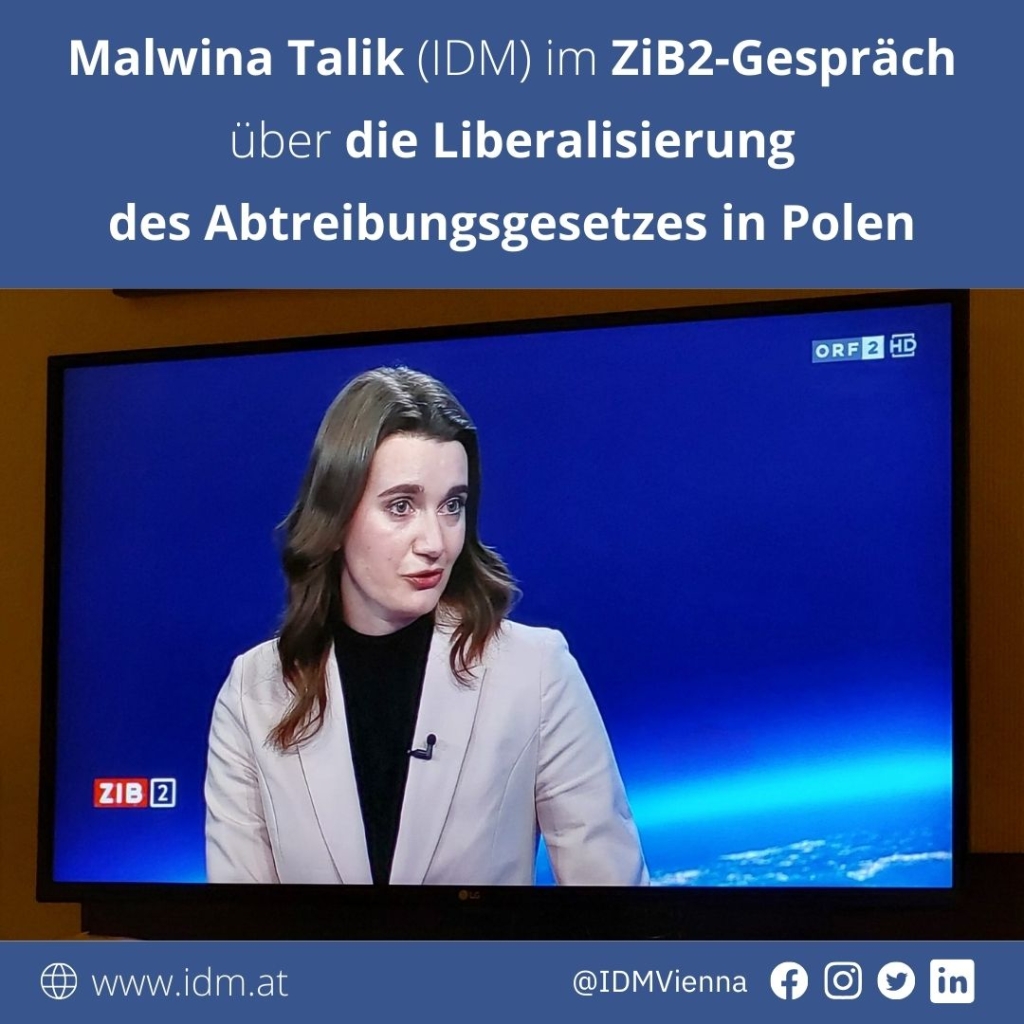
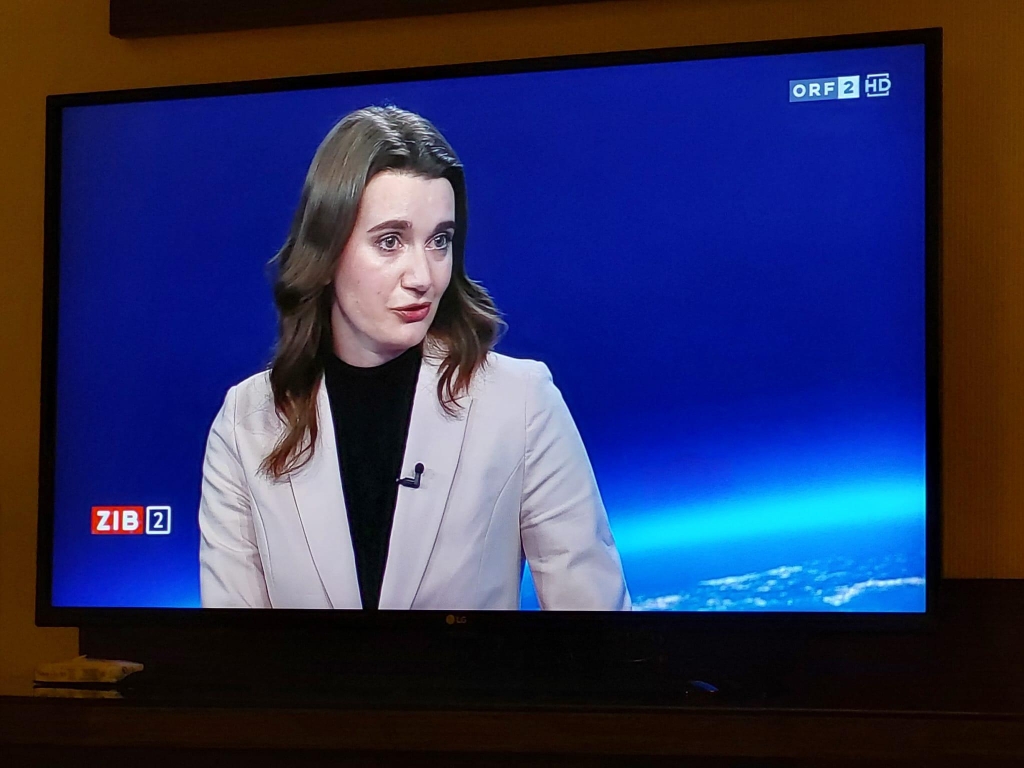
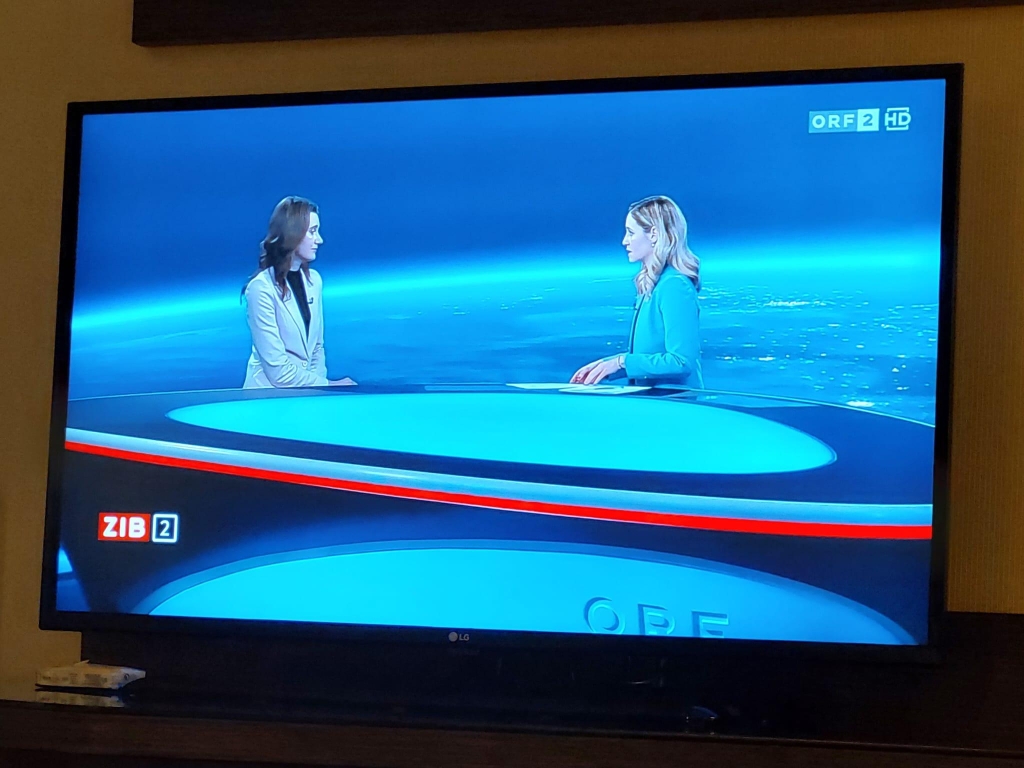
Malwina Talik im ZiB2-Gespräch über die Liberalisierung des Abtreibungsgesetzes in Polen

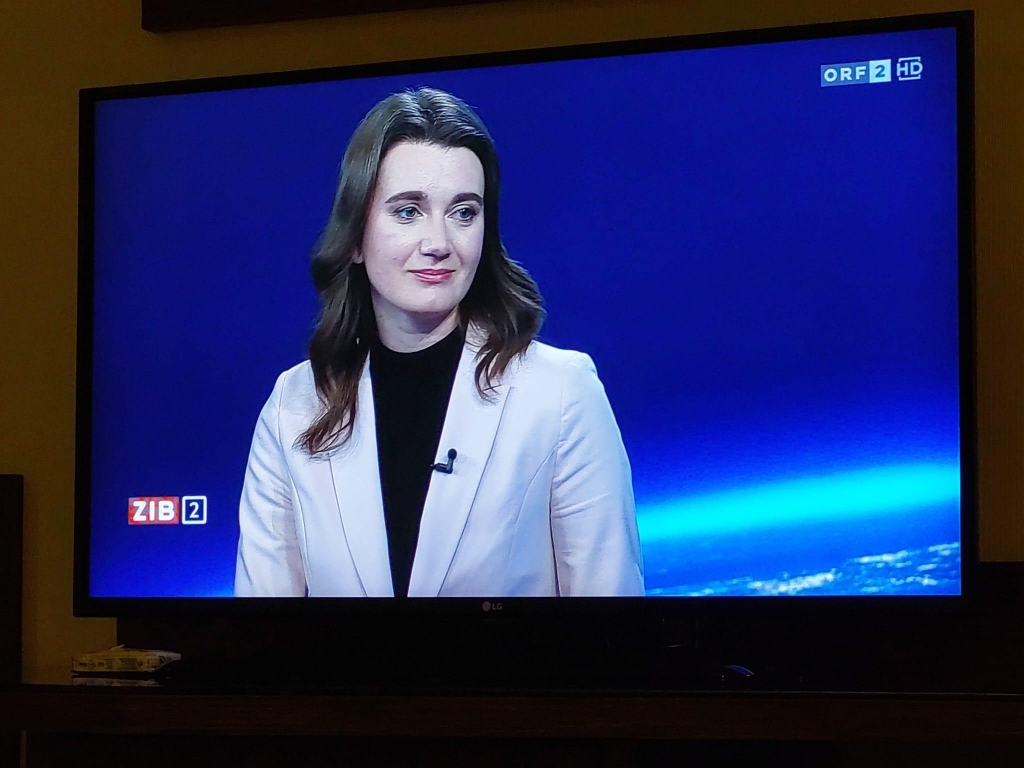
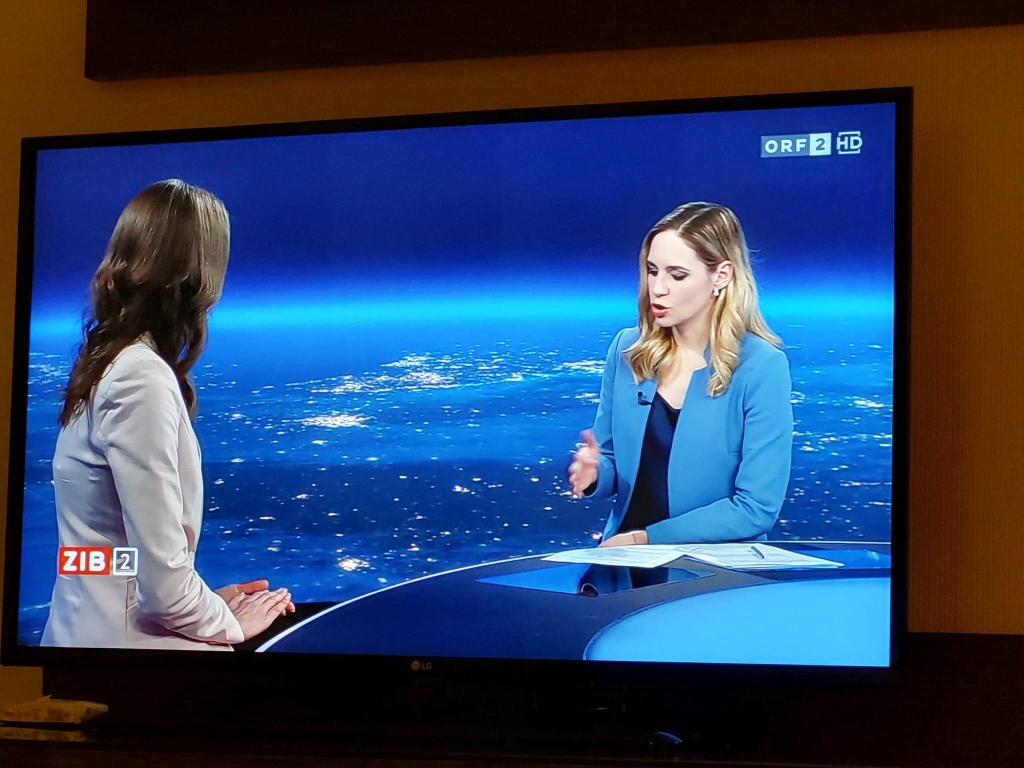
Malwina Talik (IDM) war am 25. Jänner in der ZiB2 bei Margit Laufer zu Gast. Dort hat sie die Pläne zur Liberalisierung des Abtreibungsgesetzes in Polen analysiert und mögliche Hürden besprochen.

Sehen Sie sich das Interview hier an.

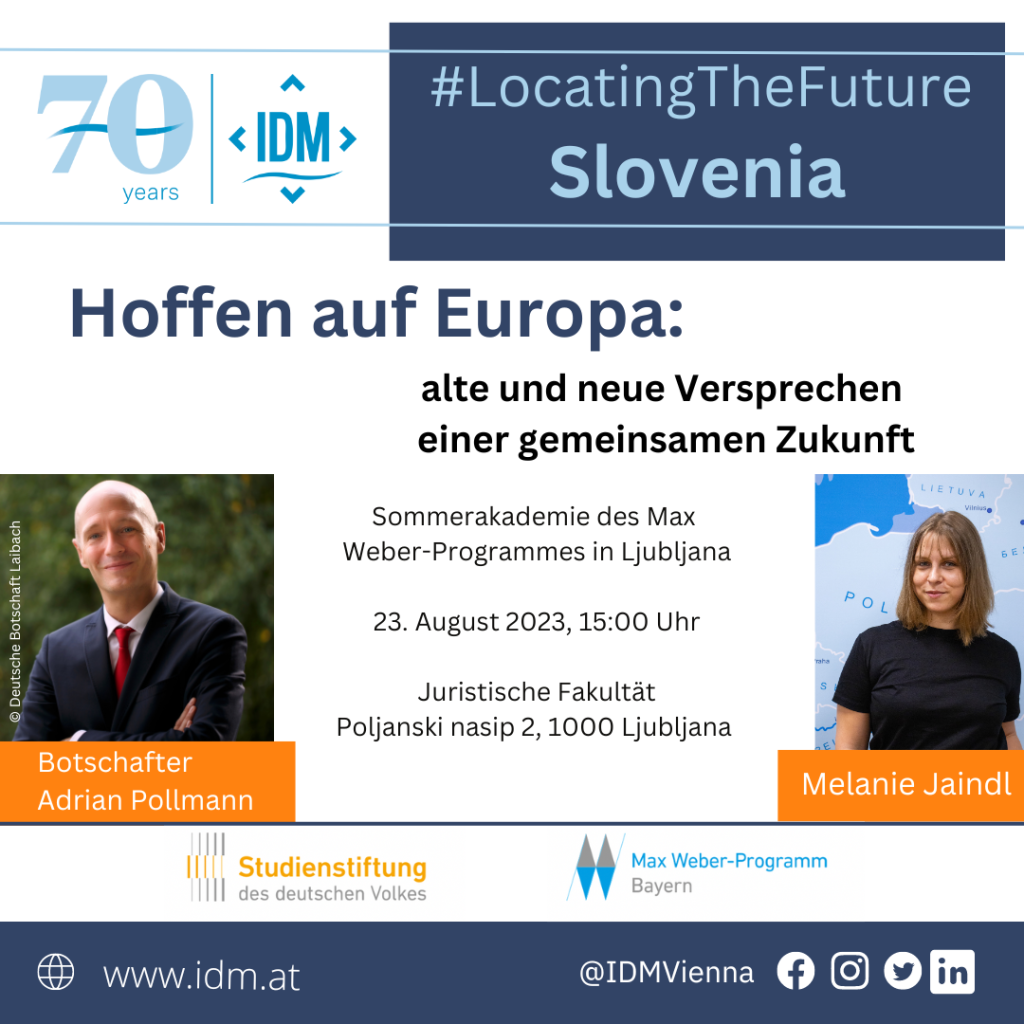
Hoffen auf Europa: alte und neue Versprechen einer gemeinsamen Zukunft

70 Years IDM: Slovenia 

Gespräch mit dem deutschen Botschafter in Slowenien Adrian Pollmann im Rahmen der Sommerakademie des Max Weber-Programmes der bayerischen Landesbegabtenförderung (Studienstiftung des deutschen Volkes) 

23. August 2023, 15:00 Uhr

Juristische Fakultät, Poljanski nasip 2, 2000 Ljubljana 

Regionale Perspektiven auf den Krieg in der Ukraine

Datum/Zeit
Oktober 24, 2022
15:00 – 18:00 MESZ/MEZ

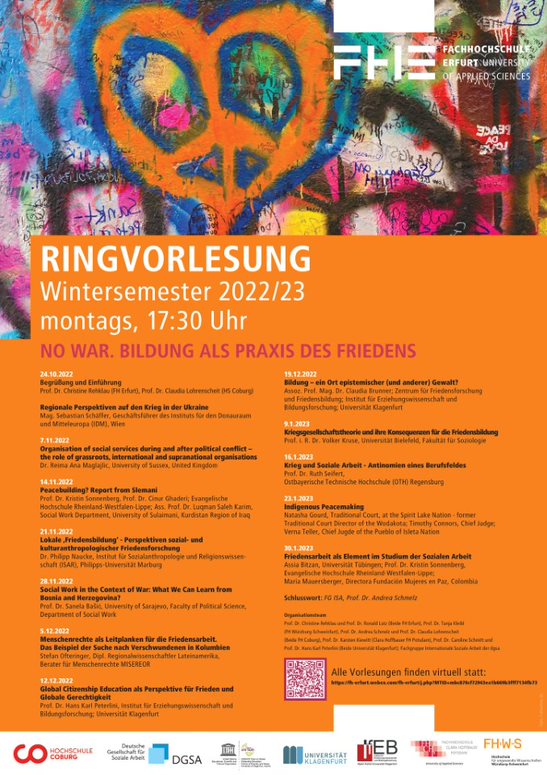
Die Fachhochschule Erfurt in Kooperation mit den Fachhochschulen Würzburg-Schweinfurt, Coburg und Potsdam sowie der Universität Klagenfurt und der Fachgruppe Internationale Soziale Arbeit der Deutschen Gesellschaft für Soziale Arbeit organisiert im Wintersemester 2022/23 eine digitale Ringvorlesung mit dem Titel No War. Bildung als Praxis des Friedens“. Zur Auftaktveranstaltung am 24. Oktober hielt IDM-Geschäftsführer Sebastian Schäffer eine Vorlesung zu “Regionale Perspektiven auf den Krieg in der Ukraine. Er skizzierte dabei zunächst die aktuelle Lage im russischen Angriffskrieg auf die Ukraine und versuchte diesen auch historisch einzuordnen. Er beschrieb darauffolgend die Entwicklungen der EU-Russland sowie Ukraine-Russland Beziehungen seit dem Zerfall der Sowjetunion und eröffnete mögliche Zukunftsszenarien für Wege aus dem Krieg. Im Anschluss diskutierte er noch mit den zahlreichen Teilnehmenden und beantwortete Fragen. Die weiteren Themen und Termine der digitalen Ringvorlesung sind im Flyer unten vermerkt, eine kostenlose Teilnahme ist ohne Registrierung möglich.  

Im Anschluss ist auch eine Publikation geplant. “Krieg und Konflikt. Peacebuilding als Herausforderung und Arbeitsfeld”, herausgegeben von Tanja Kleibl, Caroline Schmitt, Karsten Kiewitt und Ronald Lutz soll 2024 im Beltz Verlag, Juventa erscheinen. 

Autor:
Sebastian Schäffer


Das könnte Sie auch interessieren: 

Regional Perspectives on the War in Ukraine

What Is Vladimir Putin’s Endgame?

Flip-book-muster